" width="150.00000769304802px"><path d="M 0 0 L 9.184 0 L 9.184 1.944 L 0 1.944 Z" fill="rgb(21, 21, 21)" height="1.9444977770054663px" id="gOMgXCMyF" width="9.183673401240327px"/><path d="M 0 0 L 1.913 0 L 1.913 9.334 L 0 9.334 Z M 0 29.945 L 9.184 29.945 L 9.184 31.89 L 0 31.89 Z" fill="rgb(21, 21, 21)" height="31.88976450063828px" id="YKaIqSNTX" width="9.183673401240327px"/><path d="M 0 0 L 1.913 0 L 1.913 9.334 L 0 9.334 Z" fill="rgb(21, 21, 21)" height="9.33358932962625px" id="xNTPXemtb" transform="translate(0 22.556)" width="1.9132652919249722px"/><path d="M 0 0 L 9.184 0 L 9.184 1.944 L 0 1.944 Z" fill="rgb(255, 210, 0)" height="1.9444977770054663px" id="Zg1qA67Pc" transform="translate(140.816 0)" width="9.183673401240355px"/><path d="M 0 0 L 1.913 0 L 1.913 9.334 L 0 9.334 Z" fill="rgb(255, 210, 0)" height="9.333589329626221px" id="F6U7duLaT" transform="translate(148.087 0)" width="1.913265291925029px"/><path d="M 0 0 L 9.184 0 L 9.184 1.944 L 0 1.944 Z" fill="rgb(21, 21, 21)" height="1.9444977770054663px" id="vS19iM8bf" transform="translate(140.816 29.945)" width="9.183673401240355px"/><path d="M 135.077 14.558 L 136.99 14.558 L 136.99 23.891 L 135.077 23.891 Z M 4.898 11.072 C 5.528 11.072 6.009 10.838 6.34 10.371 C 6.673 9.902 6.84 9.222 6.84 8.331 C 6.84 7.44 6.673 6.761 6.34 6.294 C 6.009 5.825 5.528 5.59 4.898 5.59 C 4.269 5.59 3.785 5.826 3.446 6.297 C 3.109 6.767 2.941 7.445 2.941 8.331 C 2.941 9.217 3.109 9.895 3.446 10.366 C 3.785 10.836 4.269 11.072 4.898 11.072 Z M 2.941 5.013 C 3.348 4.468 3.798 4.066 4.291 3.807 C 4.784 3.549 5.351 3.42 5.993 3.42 C 7.127 3.42 8.059 3.878 8.786 4.794 C 9.516 5.71 9.881 6.889 9.881 8.331 C 9.881 9.773 9.516 10.953 8.786 11.871 C 8.059 12.787 7.127 13.246 5.993 13.246 C 5.351 13.246 4.784 13.116 4.291 12.858 C 3.798 12.597 3.348 12.195 2.941 11.649 L 2.941 13.002 L 0 13.002 L 0 0 L 2.941 0 Z M 18.892 6.192 C 18.634 6.069 18.377 5.979 18.121 5.922 C 17.867 5.863 17.611 5.834 17.353 5.834 C 16.597 5.834 16.015 6.081 15.606 6.575 C 15.197 7.067 14.993 7.772 14.993 8.69 L 14.993 13.002 L 12.052 13.002 L 12.052 3.644 L 14.993 3.644 L 14.993 5.182 C 15.372 4.569 15.806 4.122 16.295 3.842 C 16.786 3.56 17.375 3.42 18.06 3.42 C 18.159 3.42 18.265 3.424 18.379 3.433 C 18.495 3.44 18.662 3.458 18.881 3.486 Z M 29.544 8.299 L 29.544 9.149 L 22.665 9.149 C 22.735 9.852 22.984 10.378 23.412 10.729 C 23.84 11.081 24.437 11.256 25.204 11.256 C 25.823 11.256 26.457 11.163 27.106 10.976 C 27.756 10.788 28.425 10.506 29.11 10.128 L 29.11 12.433 C 28.414 12.7 27.718 12.902 27.021 13.039 C 26.325 13.177 25.629 13.246 24.933 13.246 C 23.267 13.246 21.971 12.815 21.047 11.954 C 20.125 11.093 19.663 9.885 19.663 8.331 C 19.663 6.805 20.117 5.606 21.023 4.733 C 21.93 3.857 23.179 3.42 24.77 3.42 C 26.216 3.42 27.374 3.863 28.242 4.748 C 29.11 5.633 29.544 6.816 29.544 8.299 Z M 26.519 7.304 C 26.519 6.736 26.356 6.278 26.03 5.93 C 25.704 5.581 25.277 5.406 24.751 5.406 C 24.181 5.406 23.718 5.569 23.362 5.895 C 23.006 6.221 22.784 6.691 22.697 7.304 Z M 35.899 8.791 C 35.286 8.791 34.823 8.897 34.513 9.109 C 34.204 9.319 34.05 9.631 34.05 10.045 C 34.05 10.423 34.174 10.72 34.423 10.935 C 34.674 11.149 35.021 11.256 35.465 11.256 C 36.018 11.256 36.483 11.055 36.862 10.652 C 37.241 10.247 37.43 9.741 37.43 9.133 L 37.43 8.791 Z M 40.398 7.663 L 40.398 13.002 L 37.43 13.002 L 37.43 11.614 C 37.036 12.183 36.591 12.597 36.096 12.858 C 35.604 13.116 35.004 13.246 34.297 13.246 C 33.343 13.246 32.569 12.963 31.974 12.398 C 31.38 11.831 31.083 11.097 31.083 10.195 C 31.083 9.097 31.453 8.292 32.195 7.78 C 32.939 7.267 34.105 7.01 35.694 7.01 L 37.43 7.01 L 37.43 6.778 C 37.43 6.304 37.246 5.957 36.878 5.738 C 36.511 5.517 35.939 5.406 35.16 5.406 C 34.53 5.406 33.944 5.47 33.4 5.599 C 32.858 5.727 32.354 5.919 31.887 6.176 L 31.887 3.896 C 32.519 3.739 33.152 3.62 33.787 3.54 C 34.423 3.46 35.059 3.42 35.694 3.42 C 37.355 3.42 38.554 3.752 39.29 4.417 C 40.029 5.082 40.398 6.164 40.398 7.663 Z M 43.136 0 L 46.077 0 L 46.077 7.077 L 49.466 3.644 L 52.885 3.644 L 48.387 7.938 L 53.238 13.002 L 49.671 13.002 L 46.077 9.101 L 46.077 13.002 L 43.136 13.002 Z" fill="rgb(21, 21, 21)" height="23.89126564493384px" id="BgbathAjS" transform="translate(13.01 7.972)" width="136.98980327397163px"/><path d="M 4.423 0 L 6.29 0 L 1.859 14.383 L 0 14.383 Z" fill="rgb(255, 210, 0)" height="14.383450056509389px" id="CwSlx98Zu" transform="translate(76.148 8.556)" width="6.290433626791241px"/><path d="M 6.921 11.414 C 6.516 11.959 6.069 12.36 5.58 12.617 C 5.092 12.874 4.528 13.002 3.888 13.002 C 2.764 13.002 1.834 12.553 1.1 11.655 C 0.367 10.754 0 9.607 0 8.214 C 0 6.816 0.367 5.671 1.1 4.778 C 1.834 3.883 2.764 3.436 3.888 3.436 C 4.528 3.436 5.092 3.564 5.58 3.821 C 6.069 4.075 6.516 4.479 6.921 5.032 L 6.921 3.644 L 9.881 3.644 L 9.881 12.058 C 9.881 13.563 9.414 14.712 8.479 15.505 C 7.544 16.298 6.189 16.694 4.414 16.694 C 3.839 16.694 3.282 16.65 2.744 16.561 C 2.207 16.472 1.668 16.335 1.126 16.152 L 1.126 13.82 C 1.64 14.122 2.143 14.346 2.636 14.494 C 3.13 14.642 3.627 14.716 4.125 14.716 C 5.09 14.716 5.796 14.501 6.245 14.072 C 6.696 13.642 6.921 12.971 6.921 12.058 Z M 4.98 5.59 C 4.371 5.59 3.897 5.819 3.557 6.278 C 3.218 6.734 3.049 7.379 3.049 8.214 C 3.049 9.073 3.213 9.723 3.541 10.165 C 3.871 10.607 4.35 10.829 4.98 10.829 C 5.594 10.829 6.071 10.6 6.411 10.144 C 6.751 9.688 6.921 9.044 6.921 8.214 C 6.921 7.379 6.751 6.734 6.411 6.278 C 6.071 5.819 5.594 5.59 4.98 5.59 Z M 12.71 0 L 15.651 0 L 15.651 13.002 L 12.71 13.002 Z M 22.606 8.791 C 21.992 8.791 21.53 8.897 21.22 9.109 C 20.911 9.319 20.757 9.631 20.757 10.045 C 20.757 10.423 20.881 10.72 21.13 10.935 C 21.381 11.149 21.728 11.256 22.172 11.256 C 22.724 11.256 23.19 11.055 23.569 10.652 C 23.948 10.247 24.137 9.741 24.137 9.133 L 24.137 8.791 Z M 27.104 7.663 L 27.104 13.002 L 24.137 13.002 L 24.137 11.614 C 23.742 12.183 23.298 12.597 22.803 12.858 C 22.31 13.116 21.711 13.246 21.004 13.246 C 20.05 13.246 19.275 12.963 18.681 12.398 C 18.086 11.831 17.789 11.097 17.789 10.195 C 17.789 9.097 18.16 8.292 18.902 7.78 C 19.646 7.267 20.812 7.01 22.401 7.01 L 24.137 7.01 L 24.137 6.778 C 24.137 6.304 23.953 5.957 23.584 5.738 C 23.218 5.517 22.646 5.406 21.867 5.406 C 21.237 5.406 20.651 5.47 20.107 5.599 C 19.565 5.727 19.06 5.919 18.594 6.176 L 18.594 3.896 C 19.225 3.739 19.858 3.62 20.493 3.54 C 21.13 3.46 21.766 3.42 22.401 3.42 C 24.062 3.42 25.26 3.752 25.997 4.417 C 26.735 5.082 27.104 6.164 27.104 7.663 Z M 37.035 3.936 L 37.035 6.208 C 36.405 5.941 35.797 5.74 35.209 5.607 C 34.623 5.473 34.07 5.406 33.549 5.406 C 32.99 5.406 32.574 5.477 32.302 5.62 C 32.032 5.763 31.897 5.981 31.897 6.275 C 31.897 6.516 32 6.7 32.205 6.829 C 32.41 6.955 32.778 7.05 33.31 7.112 L 33.828 7.187 C 35.336 7.381 36.35 7.701 36.869 8.147 C 37.39 8.592 37.65 9.292 37.65 10.246 C 37.65 11.242 37.288 11.991 36.564 12.494 C 35.841 12.995 34.763 13.246 33.328 13.246 C 32.72 13.246 32.09 13.196 31.439 13.098 C 30.79 13 30.123 12.854 29.438 12.66 L 29.438 10.387 C 30.025 10.676 30.627 10.893 31.242 11.04 C 31.859 11.184 32.486 11.256 33.121 11.256 C 33.697 11.256 34.13 11.176 34.42 11.016 C 34.711 10.853 34.857 10.613 34.857 10.294 C 34.857 10.026 34.757 9.827 34.557 9.697 C 34.357 9.567 33.958 9.466 33.36 9.393 L 32.842 9.326 C 31.531 9.158 30.613 8.849 30.087 8.398 C 29.561 7.947 29.298 7.262 29.298 6.342 C 29.298 5.351 29.632 4.616 30.3 4.139 C 30.97 3.659 31.995 3.42 33.375 3.42 C 33.919 3.42 34.489 3.461 35.085 3.545 C 35.684 3.627 36.334 3.757 37.035 3.936 Z M 47.056 3.936 L 47.056 6.208 C 46.427 5.941 45.818 5.74 45.231 5.607 C 44.645 5.473 44.091 5.406 43.571 5.406 C 43.011 5.406 42.595 5.477 42.324 5.62 C 42.054 5.763 41.918 5.981 41.918 6.275 C 41.918 6.516 42.021 6.7 42.226 6.829 C 42.432 6.955 42.8 7.05 43.331 7.112 L 43.849 7.187 C 45.358 7.381 46.372 7.701 46.891 8.147 C 47.412 8.592 47.672 9.292 47.672 10.246 C 47.672 11.242 47.31 11.991 46.585 12.494 C 45.863 12.995 44.784 13.246 43.35 13.246 C 42.741 13.246 42.111 13.196 41.461 13.098 C 40.812 13 40.145 12.854 39.459 12.66 L 39.459 10.387 C 40.046 10.676 40.648 10.893 41.263 11.04 C 41.881 11.184 42.507 11.256 43.142 11.256 C 43.719 11.256 44.152 11.176 44.441 11.016 C 44.732 10.853 44.878 10.613 44.878 10.294 C 44.878 10.026 44.778 9.827 44.578 9.697 C 44.378 9.567 43.979 9.466 43.381 9.393 L 42.863 9.326 C 41.553 9.158 40.635 8.849 40.109 8.398 C 39.583 7.947 39.32 7.262 39.32 6.342 C 39.32 5.351 39.654 4.616 40.322 4.139 C 40.992 3.659 42.017 3.42 43.397 3.42 C 43.941 3.42 44.511 3.461 45.107 3.545 C 45.705 3.627 46.355 3.757 47.056 3.936 Z" fill="rgb(21, 21, 21)" height="16.694290834220567px" id="dLc4QLWwi" transform="translate(93.176 7.972)" width="47.67206679668203px"/></g></svg>)

Table of contents
Share on Social Media
Most thought leadership is bullsh*t
A few years ago, the phrase "thought leadership" still meant something.
Today it's been stretched to cover anything an executive posts on LinkedIn, anything an agency writes for an executive on LinkedIn, anything an analyst publishes that summarizes what other analysts have already published, and anything anyone produces with the word "framework" in it.
In Harris Poll's research on the category, two-thirds of executives said all the thought leadership in their industry looks the same. Among C-suite executives, it was 70%. [1]
That's a striking thing for executives to admit. The phrase exists to signal that one firm has something distinctive to say. The people it's aimed at are telling researchers, on the record, that it doesn't.
This piece is about why that happened and what to do about it. The short version: real thought leadership requires producing knowledge that didn't exist before you produced it. Most of what gets called thought leadership today does not do that, which is why most of it is bullshit.
The word stopped meaning anything
Two forces collapsed the category.
The first is volume. The cost of producing fluent, professional-sounding content has fallen to roughly zero. A managing partner with a few minutes and a chat window can produce a thousand-word post on the future of any industry. A marketing coordinator can run a generative tool over a transcript and ship a polished blog the same afternoon. None of it requires saying anything that wasn't already in the model's training data, which means none of it has to be new.
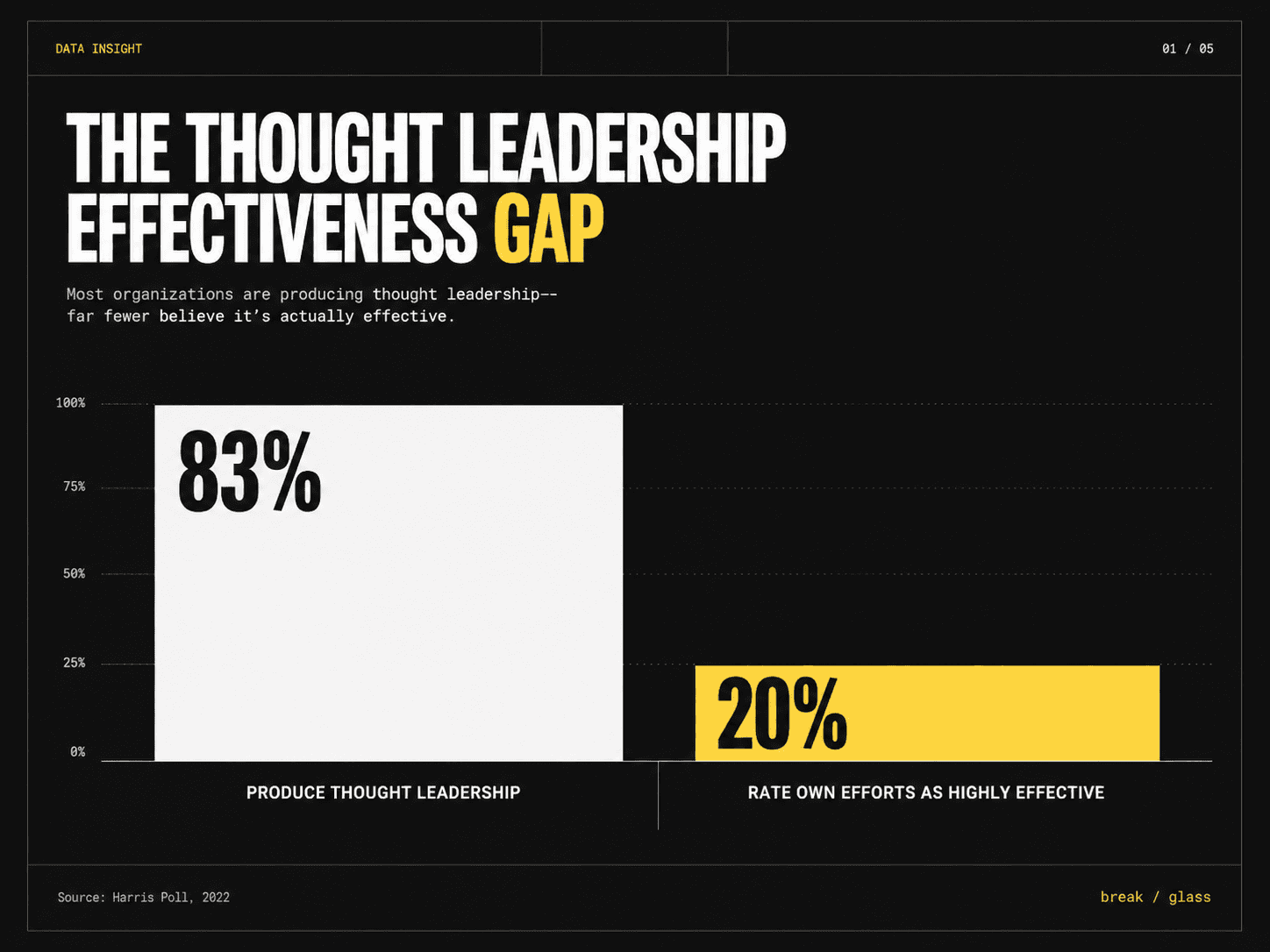
The second is laxity in how the category gets defined. Harris Poll found that 83% of organizations produce some form of thought leadership, but only 20% rate their own as highly effective. Nine in ten executives say a robust strategy is essential and only one in five thinks their own efforts qualify. [1]
The gap between participation and quality is the category, and it's enormous.
What gets produced in that gap is the dominant form of thought leadership today: a steady output of opinion pieces, trend predictions, and summaries of other people's work, dressed in the visual language of seriousness. It's recognizable on sight. Every consulting firm has some version of it on its website. None of it makes anyone want to hire the firm that published it, because none of it tells the reader anything they couldn't have found in twenty other places.
To be a thought leader, you have to be a knowledge producer
The phrase should mean what it literally says.
A thought leader is someone who leads thinking. You cannot lead thinking by summarizing thinking that already happened. You lead it by producing knowledge that the rest of the field then has to react to.
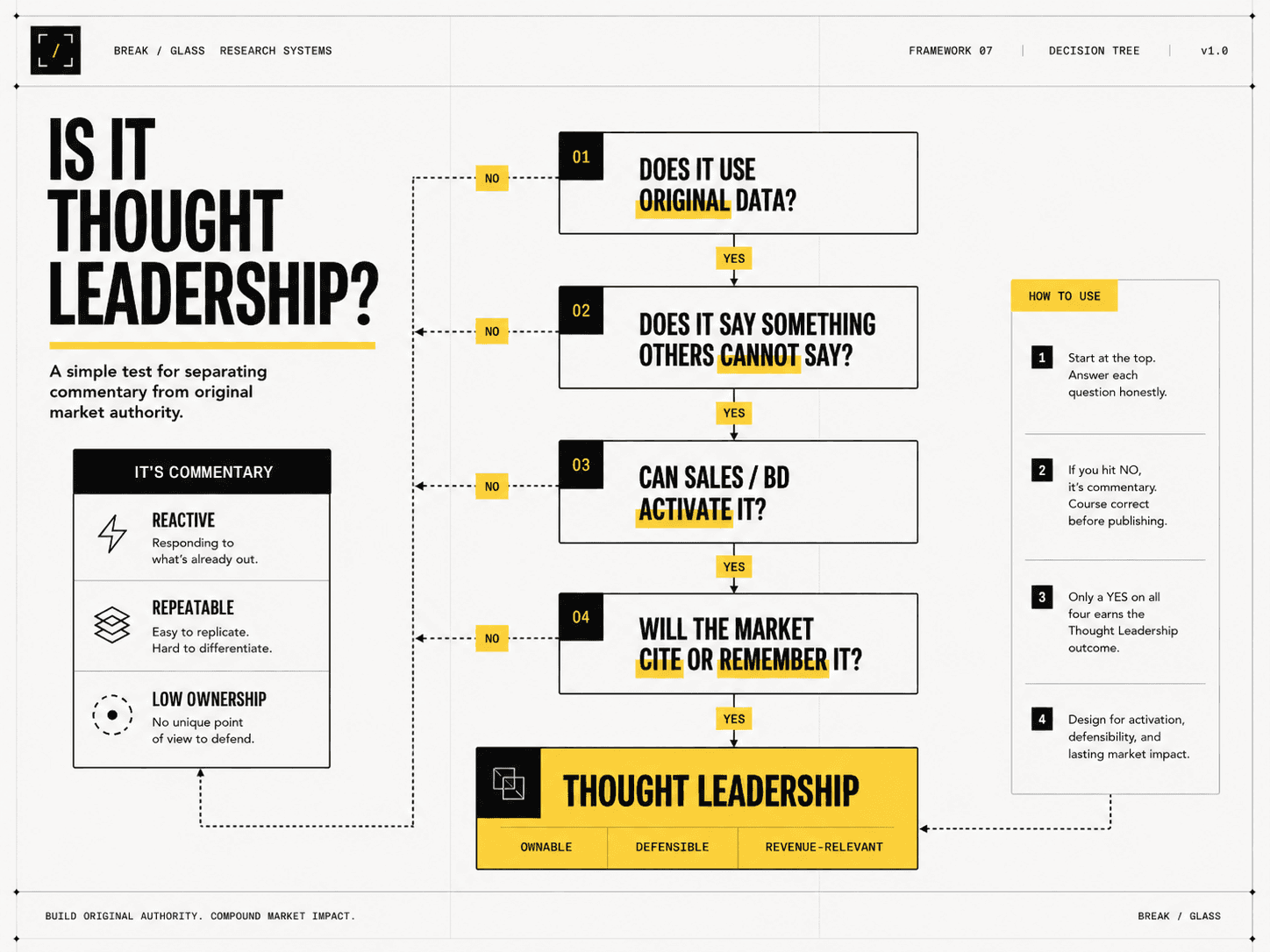
That's the only test that matters. Did you produce a finding, a number, a framework, a longitudinal pattern, or a piece of analysis that didn't exist before you did it? If the answer is no, what you produced is commentary. Commentary has its uses. But it is not thought leadership.
This sounds obvious when stated plainly. In practice almost nobody operates by it. The professional services world has converged on a model where "thought leadership" means "writing with an opinion," and the opinion is usually a mild restatement of the consensus position in whatever vertical the firm serves. There is a reason no one cites it.
The firms that get cited do something different. They produce knowledge.
What original knowledge actually looks like
A handful of consulting research programs anchor the category. McKinsey Global Institute publishes long-form economic research, often based on original datasets, that economists and journalists cite because nobody else has the data. BCG's Henderson Institute does roughly the same with management theory. Bain's annual Global Private Equity Report is the document the PE industry actually reads, because Bain's data on the asset class is more complete than what's available anywhere else. Deloitte Insights, McKinsey Quarterly, the Boston Consulting Group reports on AI adoption: all of these are anchored in original research and proprietary data analysis.
This is the part of the consulting industry that produces knowledge other people then react to.
It's also the part that nobody confuses with content marketing.
The work has a few common features. It starts from a question that nobody else has answered. It involves some kind of original data collection or analysis, which costs money. It produces findings that are specific enough to disagree with. And it gets repeated by people who weren't paid to repeat it, which is the only useful definition of resonance.
What it isn't is the executive LinkedIn post about leadership lessons, the recap of a Gartner report, or the 12-page PDF that mostly hedges. The output of a real research program does not look like the output of a content calendar, because the work that produced it was different.
Why most firms quietly avoid producing it
Producing original research is hard. It is expensive, slow, and risky in a way that recycled commentary is not.
The expensive part is obvious. A survey of a decent sample of mid-level B2B buyers runs $10,000 to $40,000 at the recruitment stage alone. C-suite respondents cost significantly more. Designing the survey to produce a real finding takes meaningful time from someone who knows what they are doing. Analyzing it properly takes more. The total cost of one credible study can exceed what a firm typically spends on content for an entire quarter.
The slow part is also obvious. From a research question to a published finding is a six-week project at minimum, and that's if everything goes well. Most firms cannot tolerate that timeline against a content calendar that expects a deliverable a week.
The risky part is the one nobody talks about. Original research can come back with findings the firm doesn't want to publish. The data might say the opposite of what the partner has been telling clients for a decade. It might confirm what everyone already knows, in which case the firm has spent $15,000 to produce nothing. Or it might say something true but inconvenient about how the firm's own market actually behaves. Each of these is a more uncomfortable outcome than what happens when a partner publishes a confident opinion piece, which is approximately nothing.
So most firms route around it. They produce more content faster. They publish more partner perspectives. They hire an agency that promises to make their LinkedIn presence "consistent." They participate in the category in the only form they can sustain, which is the form that has stopped working.
What buyers actually do with real research
When you look at how decision-makers respond to thought leadership, the difference between commentary and original research is visible in the data.
The 2025 Edelman and LinkedIn B2B Thought Leadership Impact Report surveyed nearly 2,000 professionals about how thought leadership affects their behavior in actual buying processes. 79% of hidden decision-makers, the internal stakeholders who influence purchase decisions without being the primary buyer, said they were more likely to champion an RFP proposal from a firm with strong thought leadership. 71% said high-quality thought leadership was more effective than conventional marketing materials at demonstrating a vendor's potential value. 53% said that when thought leadership quality is high, brand recognition matters less. [2]
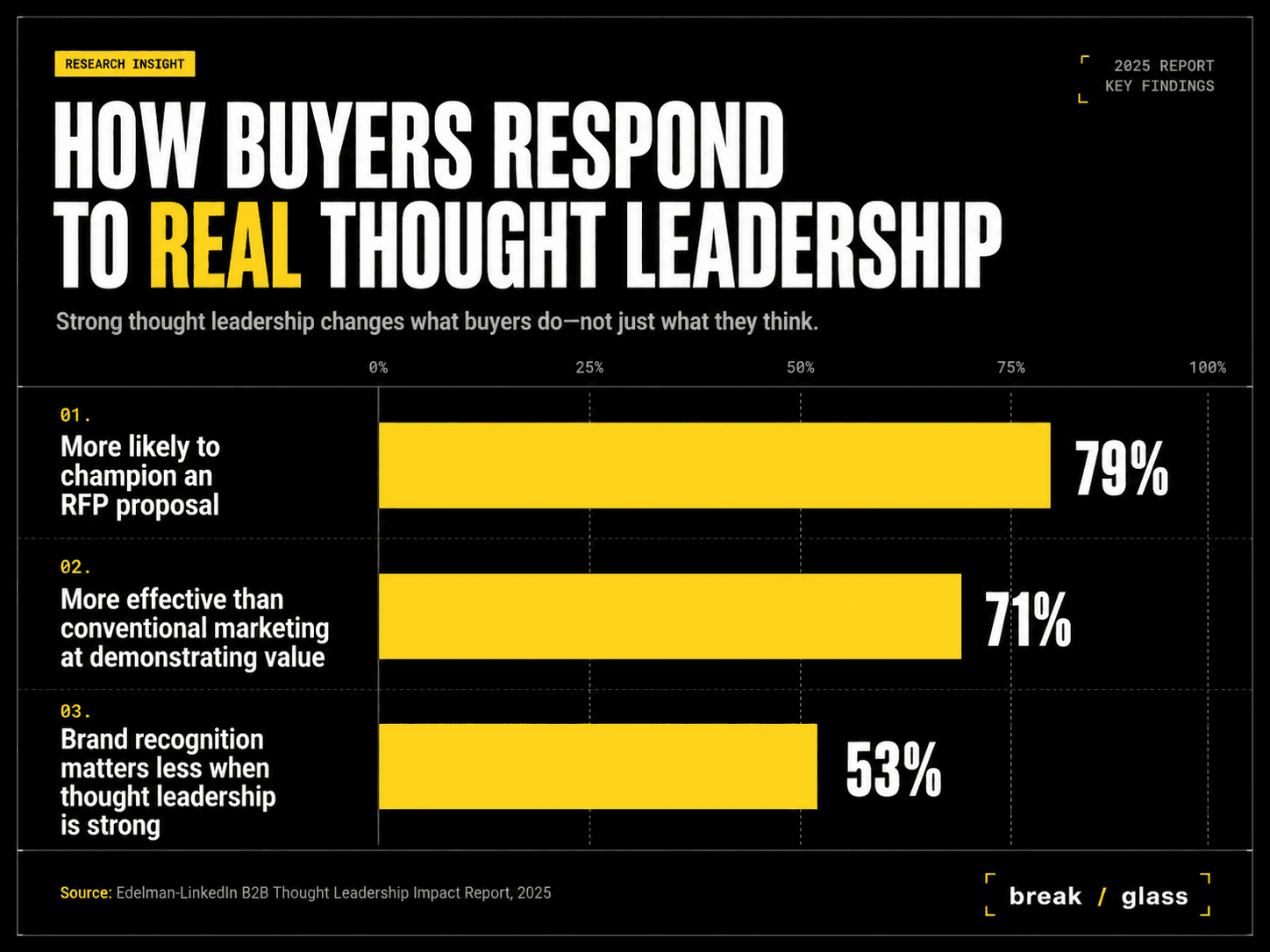
That last finding is the most important one. A firm that publishes work strong enough to be cited can compete with firms that are more famous. The data is consistent with what anyone who has been on a buying committee already knows. People champion vendors who have published something they remember.
The Harris Poll data is consistent with this. 94% of executives in that study said custom research makes thought leadership more effective. Executives who are buying B2B services are telling researchers, on the record, that the thing that moves them is original work. [1]
None of this triggers for commentary. The effect on a buyer of a partner publishing a take on macroeconomic uncertainty is roughly zero. The effect of a firm publishing a benchmark study with original data on the buyer's specific industry is not. That is the entire mechanism by which thought leadership produces business outcomes, and it only fires for original work.
Pick one question and own it for a year (or more)
If you take the argument seriously, the path forward is narrower than it first appears.
Most firms cannot produce a major piece of original research every week or every month. The point isn't to. The point is to pick one question your firm is uniquely positioned to answer and commit to producing a real, defensible finding on it over the course of a year.
A few things to look for when picking the question:
It should be a question your firm's clients ask, or should be asking. If the question is interesting in the abstract but not relevant to the work, it won't generate revenue. The research has to live downstream of how you actually win work.
It should be answerable with data your firm can plausibly collect. A question whose answer requires a million-dollar dataset is the wrong question.
It should be a question whose answer is not already obvious. If you can predict the finding before you do the research, the research isn't worth doing.
It should produce a number, a benchmark, a longitudinal pattern, or a framework that other people can cite. The output has to be the kind of thing that gets repeated.
Once you have the question, the rest of the year is execution. Design the research, collect the data, analyze it carefully, publish the finding. Make the finding the spine of every other piece of content the firm produces for the year. Talk about it in proposals. Reference it in conference talks. Send the executive summary to every prospect.
The discipline is in choosing the one question and refusing to dilute the work by producing more content around questions you didn't research. Most firms try to do everything and end up producing the kind of generic content that 70% of C-suite executives say all looks the same. The firms that get cited do less and go deeper.
Pick the question. Do the work. The rest follows.
Sources
The Harris Poll. "The ROI of Thought Leadership." 2022. https://theharrispoll.com/insights-news/reports/the-roi-of-thought-leadership/
Edelman and LinkedIn. "2025 B2B Thought Leadership Impact Report." 2025. https://www.edelman.com/expertise/Business-Marketing/2025-b2b-thought-leadership-report
Most thought leadership is bullsh*t
A few years ago, the phrase "thought leadership" still meant something.
Today it's been stretched to cover anything an executive posts on LinkedIn, anything an agency writes for an executive on LinkedIn, anything an analyst publishes that summarizes what other analysts have already published, and anything anyone produces with the word "framework" in it.
In Harris Poll's research on the category, two-thirds of executives said all the thought leadership in their industry looks the same. Among C-suite executives, it was 70%. [1]
That's a striking thing for executives to admit. The phrase exists to signal that one firm has something distinctive to say. The people it's aimed at are telling researchers, on the record, that it doesn't.
This piece is about why that happened and what to do about it. The short version: real thought leadership requires producing knowledge that didn't exist before you produced it. Most of what gets called thought leadership today does not do that, which is why most of it is bullshit.
The word stopped meaning anything
Two forces collapsed the category.
The first is volume. The cost of producing fluent, professional-sounding content has fallen to roughly zero. A managing partner with a few minutes and a chat window can produce a thousand-word post on the future of any industry. A marketing coordinator can run a generative tool over a transcript and ship a polished blog the same afternoon. None of it requires saying anything that wasn't already in the model's training data, which means none of it has to be new.
The second is laxity in how the category gets defined. Harris Poll found that 83% of organizations produce some form of thought leadership, but only 20% rate their own as highly effective. Nine in ten executives say a robust strategy is essential and only one in five thinks their own efforts qualify. [1]
The gap between participation and quality is the category, and it's enormous.
What gets produced in that gap is the dominant form of thought leadership today: a steady output of opinion pieces, trend predictions, and summaries of other people's work, dressed in the visual language of seriousness. It's recognizable on sight. Every consulting firm has some version of it on its website. None of it makes anyone want to hire the firm that published it, because none of it tells the reader anything they couldn't have found in twenty other places.
To be a thought leader, you have to be a knowledge producer
The phrase should mean what it literally says.
A thought leader is someone who leads thinking. You cannot lead thinking by summarizing thinking that already happened. You lead it by producing knowledge that the rest of the field then has to react to.
That's the only test that matters. Did you produce a finding, a number, a framework, a longitudinal pattern, or a piece of analysis that didn't exist before you did it? If the answer is no, what you produced is commentary. Commentary has its uses. But it is not thought leadership.
This sounds obvious when stated plainly. In practice almost nobody operates by it. The professional services world has converged on a model where "thought leadership" means "writing with an opinion," and the opinion is usually a mild restatement of the consensus position in whatever vertical the firm serves. There is a reason no one cites it.
The firms that get cited do something different. They produce knowledge.
What original knowledge actually looks like
A handful of consulting research programs anchor the category. McKinsey Global Institute publishes long-form economic research, often based on original datasets, that economists and journalists cite because nobody else has the data. BCG's Henderson Institute does roughly the same with management theory. Bain's annual Global Private Equity Report is the document the PE industry actually reads, because Bain's data on the asset class is more complete than what's available anywhere else. Deloitte Insights, McKinsey Quarterly, the Boston Consulting Group reports on AI adoption: all of these are anchored in original research and proprietary data analysis.
This is the part of the consulting industry that produces knowledge other people then react to.
It's also the part that nobody confuses with content marketing.
The work has a few common features. It starts from a question that nobody else has answered. It involves some kind of original data collection or analysis, which costs money. It produces findings that are specific enough to disagree with. And it gets repeated by people who weren't paid to repeat it, which is the only useful definition of resonance.
What it isn't is the executive LinkedIn post about leadership lessons, the recap of a Gartner report, or the 12-page PDF that mostly hedges. The output of a real research program does not look like the output of a content calendar, because the work that produced it was different.
Why most firms quietly avoid producing it
Producing original research is hard. It is expensive, slow, and risky in a way that recycled commentary is not.
The expensive part is obvious. A survey of a decent sample of mid-level B2B buyers runs $10,000 to $40,000 at the recruitment stage alone. C-suite respondents cost significantly more. Designing the survey to produce a real finding takes meaningful time from someone who knows what they are doing. Analyzing it properly takes more. The total cost of one credible study can exceed what a firm typically spends on content for an entire quarter.
The slow part is also obvious. From a research question to a published finding is a six-week project at minimum, and that's if everything goes well. Most firms cannot tolerate that timeline against a content calendar that expects a deliverable a week.
The risky part is the one nobody talks about. Original research can come back with findings the firm doesn't want to publish. The data might say the opposite of what the partner has been telling clients for a decade. It might confirm what everyone already knows, in which case the firm has spent $15,000 to produce nothing. Or it might say something true but inconvenient about how the firm's own market actually behaves. Each of these is a more uncomfortable outcome than what happens when a partner publishes a confident opinion piece, which is approximately nothing.
So most firms route around it. They produce more content faster. They publish more partner perspectives. They hire an agency that promises to make their LinkedIn presence "consistent." They participate in the category in the only form they can sustain, which is the form that has stopped working.
What buyers actually do with real research
When you look at how decision-makers respond to thought leadership, the difference between commentary and original research is visible in the data.
The 2025 Edelman and LinkedIn B2B Thought Leadership Impact Report surveyed nearly 2,000 professionals about how thought leadership affects their behavior in actual buying processes. 79% of hidden decision-makers, the internal stakeholders who influence purchase decisions without being the primary buyer, said they were more likely to champion an RFP proposal from a firm with strong thought leadership. 71% said high-quality thought leadership was more effective than conventional marketing materials at demonstrating a vendor's potential value. 53% said that when thought leadership quality is high, brand recognition matters less. [2]
That last finding is the most important one. A firm that publishes work strong enough to be cited can compete with firms that are more famous. The data is consistent with what anyone who has been on a buying committee already knows. People champion vendors who have published something they remember.
The Harris Poll data is consistent with this. 94% of executives in that study said custom research makes thought leadership more effective. Executives who are buying B2B services are telling researchers, on the record, that the thing that moves them is original work. [1]
None of this triggers for commentary. The effect on a buyer of a partner publishing a take on macroeconomic uncertainty is roughly zero. The effect of a firm publishing a benchmark study with original data on the buyer's specific industry is not. That is the entire mechanism by which thought leadership produces business outcomes, and it only fires for original work.
Pick one question and own it for a year (or more)
If you take the argument seriously, the path forward is narrower than it first appears.
Most firms cannot produce a major piece of original research every week or every month. The point isn't to. The point is to pick one question your firm is uniquely positioned to answer and commit to producing a real, defensible finding on it over the course of a year.
A few things to look for when picking the question:
It should be a question your firm's clients ask, or should be asking. If the question is interesting in the abstract but not relevant to the work, it won't generate revenue. The research has to live downstream of how you actually win work.
It should be answerable with data your firm can plausibly collect. A question whose answer requires a million-dollar dataset is the wrong question.
It should be a question whose answer is not already obvious. If you can predict the finding before you do the research, the research isn't worth doing.
It should produce a number, a benchmark, a longitudinal pattern, or a framework that other people can cite. The output has to be the kind of thing that gets repeated.
Once you have the question, the rest of the year is execution. Design the research, collect the data, analyze it carefully, publish the finding. Make the finding the spine of every other piece of content the firm produces for the year. Talk about it in proposals. Reference it in conference talks. Send the executive summary to every prospect.
The discipline is in choosing the one question and refusing to dilute the work by producing more content around questions you didn't research. Most firms try to do everything and end up producing the kind of generic content that 70% of C-suite executives say all looks the same. The firms that get cited do less and go deeper.
Pick the question. Do the work. The rest follows.
Sources
The Harris Poll. "The ROI of Thought Leadership." 2022. https://theharrispoll.com/insights-news/reports/the-roi-of-thought-leadership/
Edelman and LinkedIn. "2025 B2B Thought Leadership Impact Report." 2025. https://www.edelman.com/expertise/Business-Marketing/2025-b2b-thought-leadership-report